[Français | English]
For some years now, it has become a general trend to attempt to master the processing of pictures and sounds in a numerical and digital manner. This approach is appealing and has a definite efficiency on avoiding certain usual disturbances of the processing of the signals. To do so means processing a volume of information bits that the user does not imagine! For example, a compact disc holds over 5 billions of bits of informations!Unfortunately, part of these basic signals are lost before they have been processed by the Hi-Fi system, either before or during the burning of the CD, or and mainly, while the CD is read It is extremely important that the compact discs are kept perfectly clean, and that the disc reading is performed over a perfectly stable system. Every misread bit of information will be changed over into a more or less large block of approximately digitized data which will pervert the musical message.
Why an ICOS CD PRO player?
Considering that the compact disc is by essence the source for recorded music, we developped a CD-player which embodies our objectives in terms of music excellency. The most modern and efficient electronics will be of no use if the mechanical base is not adequate. And unfortunatelly, it is too often far from allowing the reading of all the data available on the compact disc.
The mechanical-optical block
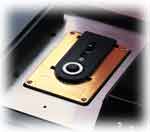
The mechanical-optical block that we selected is the latest generation of the PHILIPS CDM 12, in the version especially developped for the manufacturers of high-end equipment: the CD PRO. This block stands out because of its extremelly stable frame made of injected metal, and the directly mounted on controls which analyse with an exceptionnal accuteness all the parameters of the working of the lens. Contrary to most usual mechanics which manage the reading deficiencies ³analogically², our block runs on a real piece of an all digital software. The backside of the metallic part is accoustically treated, and the visible part is hand polished and gold plated. The disc is kept in position by a light and corrected magnetic puck in order to avoid the early aging of the motor bearings.
The intermediate frame
It is a common practice to mount the mechanical-optical block onto a swinging base made of rubber or springs. This approach tends to transform all vibrations into sidemoves which tend to increase as it goes. The sidemoves of the diode require a more complex compensating than vertical movements which means only a small loss of intensity. As the signal is digital, the loss of intensity is neglectable. We have for these reasons decided to mount the mechanical-optical block directly onto a heavy counterplate, suspended on springs working only vertically. These steel springs are specifically designed for the job, cut-out by laser (same principle as for the first loudspeaker spiders). The counterplate is made of a number of layers of different metals glued together with a passive cement.
The base frame
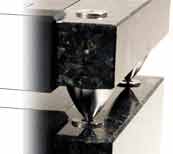
In order to minimize to the most the possible external interferences, and in order to make sure that the electronics will not be affected by any microphonic vibrations, the assembly is mounted onto a plate of granite (norwegian labradorite). This material is made of the mix of two minerals with distinct densities: this explains its neutral accoustic qualities. This is also the reason why it is used in the other ICOS ELSBERG products. In order to better integrated this assembly with its environment, it is mounted onto four large stainless steel non-linear coneshaped feet: they master the spreading of leftover vibrations. The 4cm thick top of the CD-player is cut-out of a block of massive altuglass.
The converter and the output stages
In its basic version, the ICOS CD PRO player is equiped with a «Bitstream» type converter: this converting system has the advantage of producing an extremely weak distorsion of the small signals, enhancing thereby the quality of the information bits read by the system. As the converter has a medium level impedance, no additionnal output stage has been added, avoiding thereby an unnecessary tampering of the signal. To take full advantage of the performances of this system, it is advisable to use an output cable free of all distorting and echoing. Because of the constant improving of available converters, a digital output in the EBU standard is available, internally wired with a very high flow rate cable. Room as been left available for the integrating at a later stage of a different type of converter, allowing the apparatus to be later adapted to new upcoming standards.
The power supply

The running of a CD player does not require high power, but the instant need for power, if not mastered properly, do affect considerably the listening result. This explains the choice of separating completely the power supplies for the motor, the function display, and the supply of power to the microprocessors.For obvious reasons of managing the vibrations, the power supply is external, consisting of three transformatorsmanaging 5 sections separately regulated. An oversized power supply, technically similar to the one used in the 580 DEDICACE, with a complete symetrization of the mains, is under development and will be available at a later stage.